


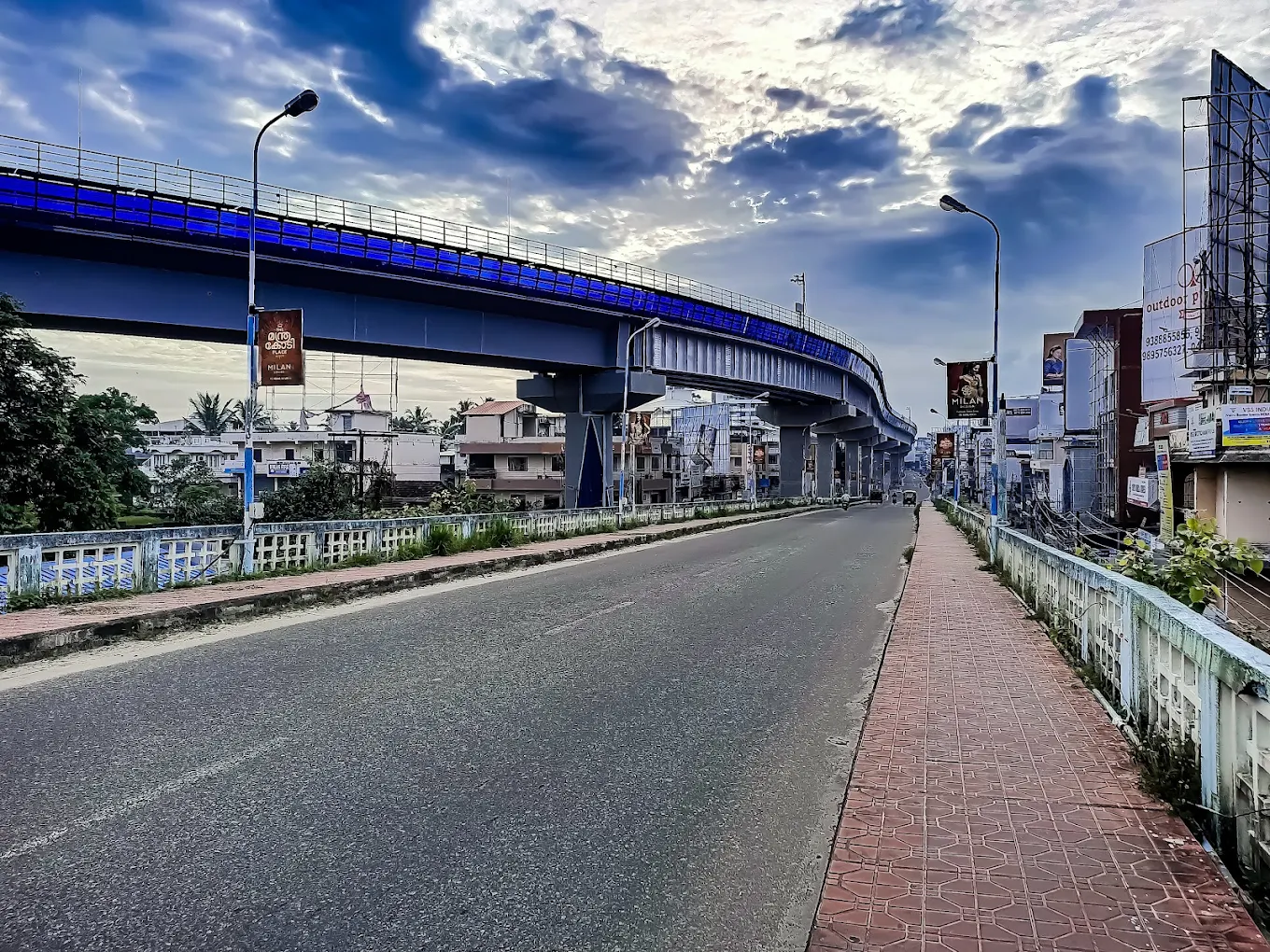
Ask a Kochi family where they would live if money were no object and Panampilly Nagar comes up more than anywhere else. It has held that position for forty years, through the city’s growth in every direction. That is unusual. Most premium addresses are overtaken. This one has not been, and the reasons are worth understanding if you are thinking of buying here.
It was planned, and the plan held
Panampilly Nagar was laid out by the Greater Cochin Development Authority in the 1970s as a planned residential scheme south of the city centre. The layout was unusual for Kerala at the time: a grid of wide avenues and numbered cross roads, generous plots, and trees planted along the streets before the houses went up.
Half a century on, the grid is intact. The roads are still wide enough for two cars to pass with parking on both sides, which is rarer in Kochi than it should be. The trees are now mature. The plot sizes have kept the density lower than the areas around it. Panampilly Nagar did not become a good address because of what was built there; it became one because of what was decided before anything was built.
What is around it
The neighbourhood sits within a few minutes of most of what a Kochi household needs.
- Kadavanthra and Elamkulam metro stations on the edge of the neighbourhood.
- Some of the city’s best-regarded schools within a short drive.
- Medical Trust, Lakeshore and Ernakulam Medical Centre all within ten to fifteen minutes.
- MG Road, Kochi’s original commercial spine, is a short drive north.
- The restaurant and café stretch along the main avenue has become one of the city’s best, without the neighbourhood ceasing to be residential.
What is changing
The original plots were built as independent houses. Over the last two decades, many have been redeveloped as apartments, because the land value now makes a single house on a Panampilly Nagar plot an expensive way to live. This is the main way new homes come to market here: not through large new developments, because there is no empty land, but through the careful redevelopment of individual plots.
That constraint shapes what gets built. A Panampilly Nagar apartment building is usually small, a handful of floors and a limited number of flats, on a plot that once held one house. The best of them respect the scale of the street. The worst overwhelm it. Buyers should look at how the building meets the road, how much of the plot is left open, and whether the setbacks and the trees have been kept.
Our building here
Arya Bhangy Rhinestone is a G+10 building of 2 and 3 BHK apartments on a single redeveloped plot, built to the scale of the street rather than against it. The families who live there have been there for years now.
One of them told us, some years after handover, that the builder still looks after the building as if it were their own. [Link to testimonial.] We put that here not as advertising but because it is the answer to the question that matters most about an address like this: not what it looks like on the day you move in, but what it is like in year five.
If you are buying here
Prices in Panampilly Nagar are among the highest per square foot in Kochi and have been for decades, which tells you something about how they hold. What you are paying for is the plan: the width of the road, the trees, the low density, the walk to the metro. Check that the building you are considering has not traded those away. Ask how much of the plot is open ground. Ask how many flats share the lift. Ask whether there is a car park for every flat, because on-street parking is the one thing the 1970s plan did not foresee.
And ask to see a building on the same street that is ten years old. In a neighbourhood that has lasted this long, the only meaningful measure of a builder is how their work ages.