


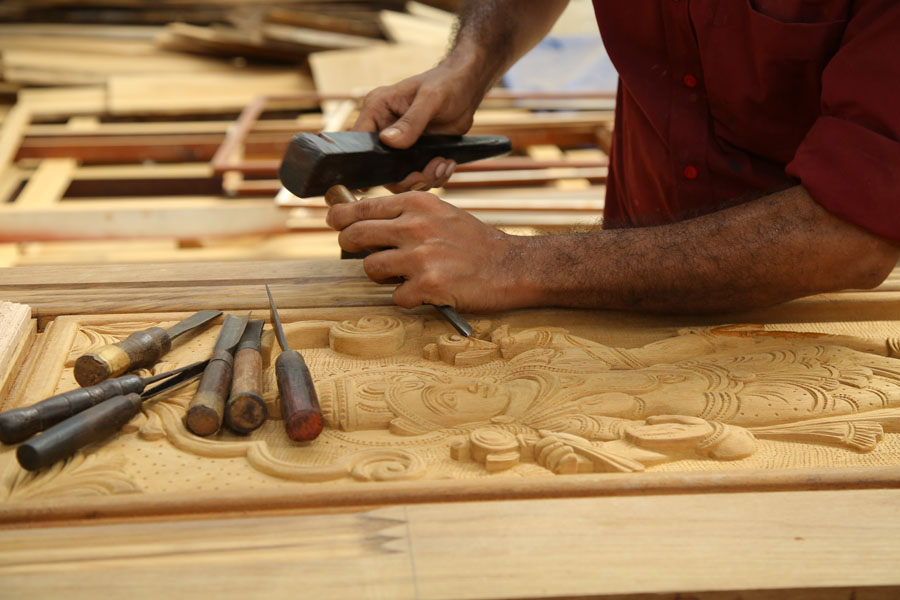
Arya Bhangy Builders is eighteen years old. The name on the door is fifty-seven. For the forty years in between, the family made one thing: handcrafted teak entrance doors, in a workshop in Kochi, sold across India. We came to construction late, and we came to it with habits already formed. This is about the one that mattered most.
The naked product
Our managing director, George Thomas, has a way of describing a front door that explains the whole company. A door, he says, is a naked product. If you make furniture, you can cover a mistake with fabric or a veneer. A door stands on its own. Every visitor sees it before they see anything else about the house, and the owner touches it every day for thirty years. You cannot hide poor work on it. So you do not do poor work.
That rule built a business that supplied doors to homes, temples, churches and public institutions across the country, and that offered a twenty-five year warranty at a time when nobody else in the trade would. It also killed off most of the competitors who copied the name over the years, because the ones who compromised were found out, and in a naked product you are always found out.
What it means in a building
A building is not a naked product. Most of what determines how it ages is invisible on the day you buy: the grade of the concrete, the cover on the steel, the waterproofing under the terrace, the fall on the bathroom floor, the quality of the plumbing inside the wall. A builder who wants to cut corners has a hundred places to do it where no buyer will ever look.
The rule we brought from the workshop is to build as if every one of those places were a front door. Not because a buyer will see it, but because in five years the building will show it, and the building has our name on the gate.
In practice that means specifying to the standard the building will need in twenty years rather than the minimum the code allows today: structural concrete tested at every pour, steel protected for a city where the air is salt, waterproofing treated as a system rather than a coat of paint, and walls built for a climate that is hot, wet and unforgiving of shortcuts. None of it is visible on the day you buy. All of it is visible in year ten.
Fewer, slower, better
The other habit that came across is patience. A carved door takes weeks. It cannot be hurried without showing, and a workshop that tries to double its output by halving its care does not stay in business for fifty years. We build the same way. We take on fewer projects than we could, and some of them take longer than a buyer might like, because there are stages in a building where speed is paid for later, by someone else.
The family on site
The standard is not delegated to a brochure. A director is on every active site regularly, and the decisions that determine how a building will age in ten years are taken by someone whose name is on the gate.
What it means for you
If you are buying a home from us, this is the promise underneath the specifications: we build the parts you will never see to the standard of the parts you will. We would rather you tested that than took it on trust. Visit a building we handed over years ago, look at how it has aged, and ask the people who live there. That is the only judgement of a builder worth having, and it is the one we were raised on.